
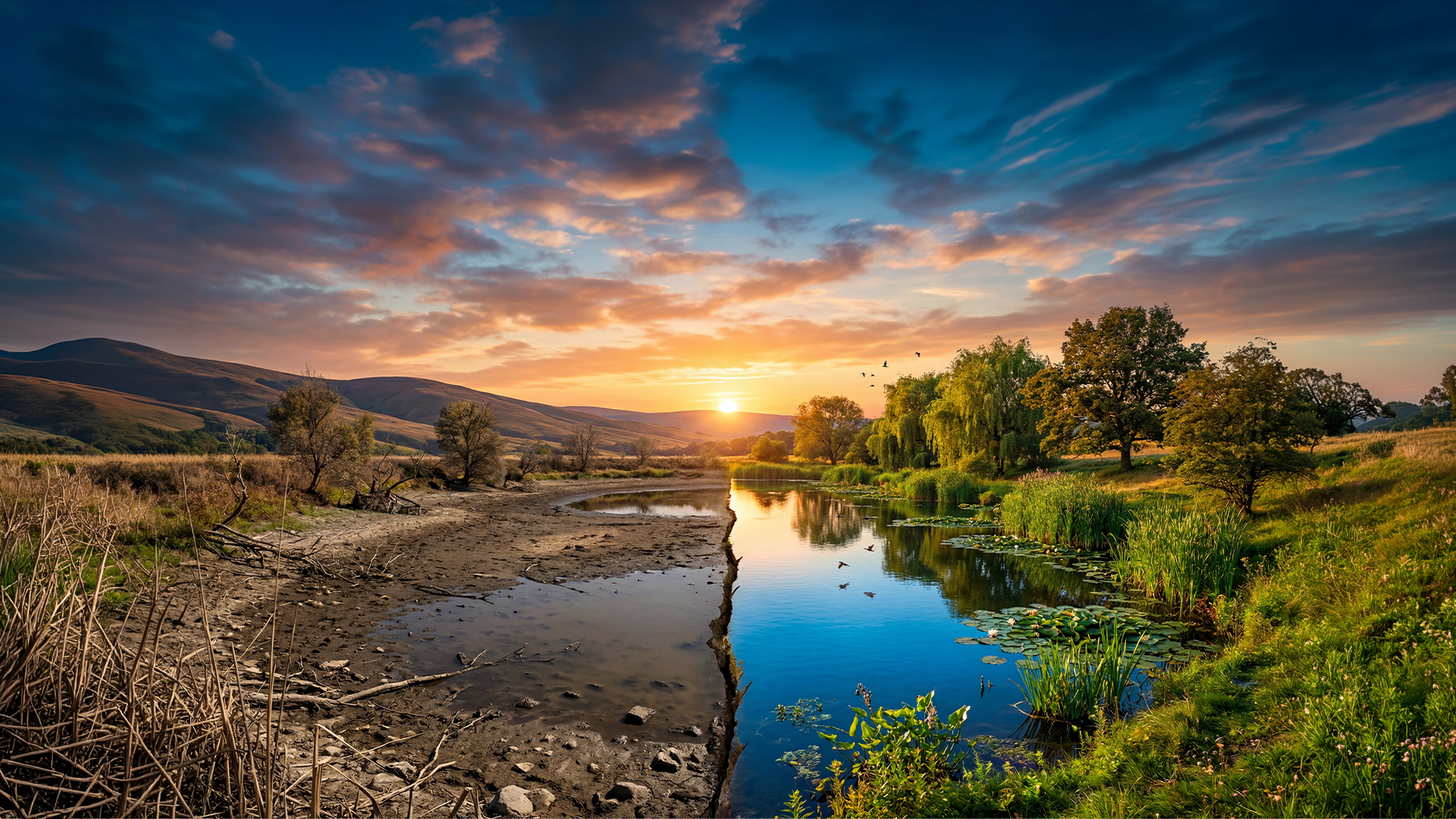
For the first time in history, the planet’s water cycle is this fragile. Rising demand, shifting climate patterns and the pressures imposed by human activity are pushing water’s natural renewal capacity to its limits. What we witness goes far beyond the depletion of resources alone; it points to a multilayered fracture stretching from ecosystems to economies. At this stage, the label of a “water crisis” no longer suffices to describe the unfolding process. A deeper concept is at play: water bankruptcy. For Eczacıbaşı Life Blog, Prof. Dr. Barış Salihoğlu, Advisor to the Rector of Middle East Technical University and Director of METU Institute of Marine Sciences and METU Climate Center, and Tolga Güneri, General Manager of Energy and Sustainability at Eczacıbaşı Holding, discussed the dynamics behind this fracture in water systems, the risks it creates, and the possible scenarios that lie ahead.
Tolga Güneri: Recently, we have been hearing concepts such as water stress, water scarcity and water risk much more frequently. We also see the term “water bankruptcy” starting to replace “water crisis.” Do you think we have reached a new threshold? Does this situation affect only freshwater resources, or the entire ecosystem extending from river basins to coastal areas?
Prof. Dr. Barış Salihoğlu:
We are now talking about a critical threshold. While concepts such as “stress” and “crisis” suggest a temporary and manageable situation, “water bankruptcy” describes a point at which excessive and unplanned use, pollution and climate pressure are pushing, and in some cases exceeding, the natural renewal capacity of certain systems. The 2026 United Nations University report highlights exactly this issue: the problem is no longer only periodic water stress, but structural degradation in some basins and the loss of irreplaceable ecosystems, in other words, an irreversible condition.
Moreover, this picture is not limited to freshwater resources alone. We are talking about a single, interconnected system stretching from rivers and groundwater to wetlands, coastal areas and marine ecosystems. Every negative impact occurring within a basin is transmitted all the way to the seas and oceans through cascading effects.
This impact becomes even more visible in sensitive ecosystems, such as deltas, lagoons, coastal wetlands, and enclosed or semi-enclosed seas. For example, excessive water withdrawal in upstream basins can depress deltas in downstream areas, weaken wetlands, and increase coastal erosion. Similarly, agricultural, domestic and industrial pollution reaches seas through rivers and directly affects water quality.
For this reason, water bankruptcy is not simply a resource issue; it means the weakening of ecosystems’ capacity to regenerate themselves, causing lasting damage. UNESCO data also shows that this is no longer a local or exceptional issue, but a systemic global problem.
The seas are one of the first environment where this process becomes evident. For countries like Türkiye that have long coastlines and increasingly experience climate pressures, and adopting this holistic perspective is no longer a choice, but a necessity.
.jpg)
“What we are facing is no longer a temporary crisis, but a structural fracture.”
Tolga Güneri: How is climate change transforming the water cycle? When drought, floods, rising temperatures and sea level rise are considered together, what lies ahead for Türkiye and similar countries?
Prof. Dr. Barış Salihoğlu: Climate change renders the water cycle more irregular and unpredictable. Transitions are becoming harsher: on one side, prolonged periods of drought; on the other, intense rainfall and floods occurring within very short periods of time. This means facing both water scarcity and flood risk simultaneously.
Rising temperatures increase evaporation, reduce soil moisture and drive up agricultural water demand. Paradoxically, it also reduces the capacity of the soil to absorb and retain water, which means that intensive precipitation, when it happens, is also washed away, making flooding more likely. So the transformation is not only about the volume of rainfall; it is also about its timing, intensity and the way water is stored.
In countries like Türkiye, this picture is compounded by coastal vulnerability. Sea level rise, saltwater intrusion, coastal flooding and the increasing vulnerability of deltas create significant risks, especially for coastal plains, wetlands and low-lying settlements. This process brings not only environmental consequences, but also economic and social impacts.
Since the Mediterranean basin is one of the regions most vulnerable to climate change, water can no longer be viewed solely as a drought issue. It must also be addressed as a matter of food security, urban resilience and ecosystem health.
For this reason, it is no longer possible to think about water policies separately from climate adaptation policies.
Tolga Güneri: Water management in industry and agriculture is no longer only about cost; it is increasingly becoming a matter of resilience and future planning. How can organizations develop this perspective?
Prof. Dr. Barış Salihoğlu: Organizations need to start viewing water not merely as a consumable input, but as a fundamental component of operational continuity and risk management. Today, access to water, water quality, seasonality and basin conditions are directly influencing production decisions.
According to UNESCO data, nearly 70 percent of global freshwater withdrawals are driven by agriculture and livestock activities, while around 20 percent is used by industry. This means the real transformation needs to happen primarily in these two sectors.
The critical point here is this: a substantial portion of the water used, and polluted, in agriculture and industry eventually reaches the seas through rivers, directly affecting coastal ecosystems. Production processes are also the starting point of the marine pollution chain. In other words, the issue goes far beyond managing the water flowing from a tap.
In this context, organizations need to focus on four key areas: accurately measuring and transparently monitoring water use, expanding water reuse and circularity practices, assessing decisions at the basin level, and integrating water considerations into strategic decision-making processes.
For organizations, water is no longer a subtopic to be addressed within sustainability reporting. It is an issue that needs to be positioned at the center of investment and supply chain strategies.
-(1)-(1).jpg)
“Companies should see water not only as a resource they use, but as a strategic asset that must be protected.”
Tolga Güneri: Over the next five years, how do you expect the way we use and manage water in cities, agriculture and daily life to change? How decisive will reuse, efficiency and digital technologies become?
Prof. Dr. Barış Salihoğlu: Over the next five years, the most visible shift in water management will be the disappearance of the perception of water as an abundant and invisible resource.
In cities, smart monitoring systems, leak and loss management, consumption tracking and the reuse of treated wastewater will become ubiquitous. For municipalities, the priority will no longer be only finding new water sources, but managing existing water resources in smarter, more efficient and more resilient ways. The fact that Türkiye’s National Water Plan clearly defines reuse targets shows that this transformation is also gaining strength at the policy level.
In agriculture, the transformation will be even more profound. Crop planning based on water availability, precision irrigation, and digital decision-support tools powered by soil moisture and climate data will become increasingly common. In daily life, greywater use, rainwater harvesting and water-efficient equipment will become more integrated into everyday practices.
This transformation will accelerate not only on land, but also across coastal and marine areas. Real-time seawater quality monitoring systems, coastal early warning mechanisms, ocean digital twin technologies and integrated observation infrastructures will become more widespread.
The core issue is not individual conservation habits alone, but system design. While individual behavior matters in building collective awareness, lasting impact can only be achieved through a fundamental shift in urban infrastructure, agricultural policies, industrial transformation and data-driven governance.
At the same time, shifts in consumption habits with high water footprints will gradually trigger broader transformation, extending from urban structures to agriculture and industry. Individual awareness creates real impact only when these choices become widespread across society.
Digital technologies are important tools that can accelerate this transformation. However, they are not a solution on their own. The real impact emerges when technology is combined with the right societal choices and strong institutional frameworks.
Tolga Güneri: In your opinion, what measures should individuals, companies and countries take regarding water?
Prof. Dr. Barış Salihoğlu: At the individual level, the most important step is to stop seeing water as an unlimited resource and to develop a proper understanding of the water cycle. Reducing unnecessary consumption in daily life and choosing water-efficient household equipment are important, but the role of individuals does not end there. Being a conscious consumer and developing awareness around water-intensive products with high environmental impact is equally decisive. Food, clothing, transportation and travel choices are all part of this equation.
For companies, water management is no longer just an environmental responsibility issue; it is directly tied to risk management and business continuity. Companies first need to accurately measure their water use, monitor it on a process level and report it transparently. In addition, they need to improve water efficiency, invest in water reuse and recovery systems, consider water-related risks across their supply chains and take into account the ecological limits of the basins in which they operate.
In short, companies should see water not only as a resource they use, but as a strategic asset that must be protected.
At the national level, the most critical need is a holistic approach to water management. Water policies need to be addressed together with policies related to agriculture, energy, industry, urbanization, climate and ecosystem protection. Countries should view water not merely as an input for economic development, but as a matter of ecological security and societal resilience.
Ultimately, creating lasting impact on water issues is only possible through the combined force of individual awareness, institutional transformation and strong public policies. Without all three working together, achieving a sustainable solution becomes extremely difficult.
“We need to manage water not by dispersing it across sectors, but as a holistic system.”
Tolga Güneri: Despite this overall picture, what developments still give you hope? How can scientific progress, the sensitivity of younger generations and a holistic management approach make a difference in this field?
Prof. Dr. Barış Salihoğlu: The most encouraging development for me is that water is no longer discussed solely as an infrastructure or conservation issue, but increasingly within the broader framework of climate adaptation, food security, ecosystem health and societal resilience. This conceptual shift is critical, because we cannot develop effective solutions without first defining the problem accurately. The shared message of international reports and new policy documents points in the same direction: we need to manage water not by dispersing it across sectors, but as a holistic system.
Another important development is the progress being made in science and technology. Remote sensing, real-time monitoring systems, data platforms, AI-supported forecasting and decision support tools enable much more proactive and effective water management. From the perspective of marine sciences and climate studies, these tools not only increase our observation capacity, but also narrow the gap between science and policy.
The third source of hope is younger generations. Young people see water not merely as a service, but as a matter of human rights, ecological justice and the future itself.
I believe the real transformation will come when technology, policy and societal awareness converge in the same direction.
At the Eczacıbaşı Group, we approach water as a strategic priority in terms of both business continuity and ecosystem resilience.
As a signatory of the United Nations Global Compact, the Eczacıbaşı Group adopted the Forward Faster Water Resilience Commitment in 2025, with the aim of strengthening water resilience across its operations and supply chain.
In 2026, we are launching a comprehensive water due diligence project to conduct a more detailed analysis of our water-related risks and opportunities, identify water reuse potential, and build a more holistic water management strategy.