
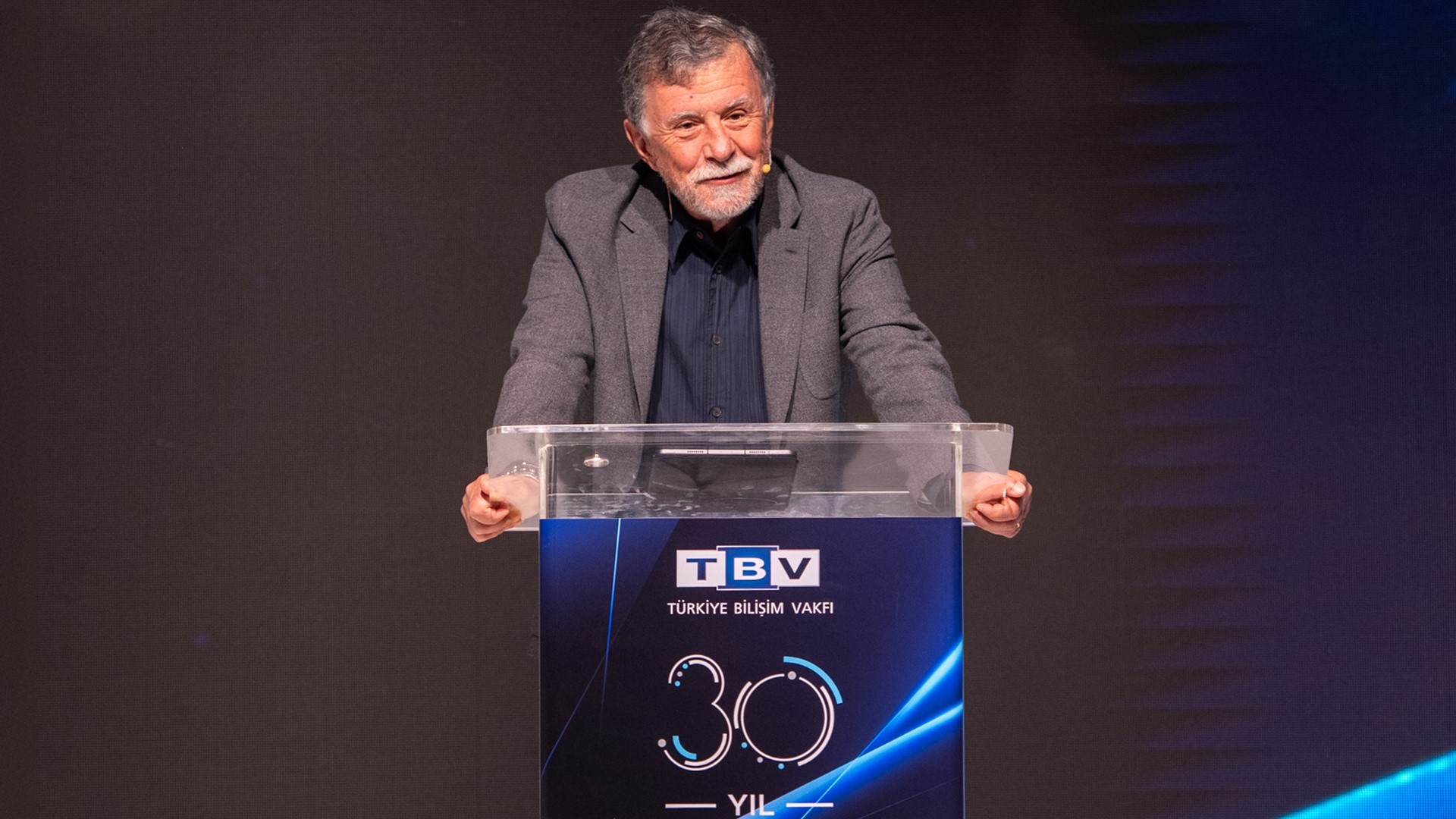
Thirty years ago, the Turkish Informatics Foundation (TBV) was founded not as an organization that explains technology, but as an NGO that tries to make sense of how technology transforms society, the economy, and culture. From the early spread of the internet to the rise of the data age and now the integration of AI into daily life, TBV’s story mirrors Türkiye’s own digital transformation.
For Eczacıbaşı Life Blog, we spoke with Faruk Eczacıbaşı, President of TBV, about what these three decades truly mean to him.
When TBV was founded, what need was it responding to?
What did the idea of a “knowledge society” mean in Türkiye at that time? What did it signify to establish an organization that aimed to understand the impact of technology-driven disruption on individuals, institutions, and society?
When we look back at the founding days of the Turkish Informatics Foundation, we were actually sensing the closure of one era and the quiet opening of another, a period whose name we could not even define yet. Türkiye felt inward-looking at the time, caught between coalition politics, daily arguments, and tabloid headlines. Meanwhile, a small group of people around the world had just started to speak about something called the “internet.”
It was such a tiny minority. There were only 39 million users globally - seven out of every ten thousand people. Today, that figure is 73 percent. Humanity reached a level of interconnectedness that would have been unimaginable only a few decades ago.
For us, the issue was never the technology itself; not cables, not servers, not the hardware. What truly interested us was how technological disruption would reshape the individual, institutions, and social structures. Our core question back then was very simple: “What is this change telling us, and how should we prepare for it?”
I encountered the internet for the first time in 1993. I was among the first ten thousand people in Türkiye. Looking back today, I understand much better what we were actually experiencing: we were standing at the threshold of the “knowledge society”; a new era in which individuals gain power, borders lose meaning, and hierarchies become more flexible. TBV was born from the instinct of a small group that sensed this threshold and said, “This is a rupture and we cannot stand still.”
Our founding vision was not to explain the world through technology; it was to help individuals, companies, the public sector, and civil society find direction in a world transformed by technology. Today, I can see much more clearly how early and how bold that vision was.
In these 30 years, what do you think TBV has done best? Could you share the three most critical achievements with concrete outcomes?
1. Shaping Türkiye’s digital transformation policies.
One of TBV’s most visible and measurable contributions has been supporting the development of policy frameworks for Türkiye’s transition to a knowledge society.
Reports we produced and negotiations we contributed to — on e-government, digitalization strategies, data protection, competitiveness, and internet access — helped lay the foundations of an ecosystem mindset that still guides policymaking today.
For an NGO, contributing ideas is not enough; embedding those ideas into the system is what truly matters.
2. Helping build Türkiye’s digital literacy and capability ecosystem.
When Türkiye had not even 30,000 internet users, we approached technology through the lens of capability-building and inclusion.
Our programs on digital awareness and skills for young people, women, and entrepreneurs became some of TBV’s strongest societal contributions in hindsight.
These efforts were never “just training programs.” They helped establish the very concept of digital literacy in Türkiye.
3. Creating a collaborative model between private sector, public sector, academia, and civil society.
Bringing these four different worlds together was meaningful.
The dynamism of the private sector, the scale of the public sector, the scientific rigor of academia, and the human-focused reach of civil society created valuable partnerships.
This allowed us to develop new models and propose new forms of governance.
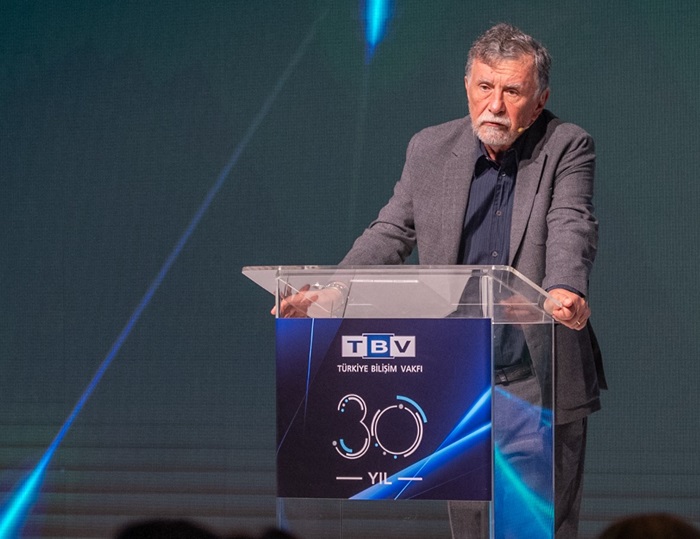
“AI today is not merely a technological leap; it is a rupture with the potential to rewrite humanity’s story. I see this period as a much deeper paradigm shift than the horizontal transformation created by the internet.”
Today, AI stands at the center of TBV’s new chapter. You often say, “We no longer use technology; we now live with it.” What are TBV’s priorities in this new paradigm? How can Türkiye turn this transformation into an opportunity?
AI today is not merely a technological leap; it is a rupture with the potential to rewrite humanity’s story. I see this period as a much deeper paradigm shift than the horizontal transformation created by the internet.
We no longer use technology as a tool we hold in our hands; we think, create, and decide with it.
That is why TBV’s new story places at its center the challenge of directing this revolution toward “technology for good” — for people and for the planet.
The real question in this age of unprecedented speed and uncertainty is: How will this rupture work for human well-being and planetary health?
TBV’s priority begins exactly here: approaching AI not as a tool for competition or efficiency alone, but as a platform for building models of sustainability, ethical governance, and societal benefit.
As our manifesto highlights, the institutions and values of the industrial paradigm cannot meet the needs of this new era. The new paradigm demands transparent algorithms, new ethical principles, fair data use, and sustainability-based performance indicators.
TBV works to establish this new framework in Türkiye: ensuring that technology is trustworthy and that technology-for-good models spread widely.
Another dimension of this vision is human capability. The skills of the future are not merely technical; they include systems thinking, ethical judgment, collective intelligence, resilience in crises, and the ability to generate value from uncertainty.
Türkiye’s young population is an advantage here. When “fluid minds” open to change and fast learning, work together with the wisdom of “crystallized minds,” technology becomes a driver not only of economic growth but of societal empowerment.
TBV is developing new learning models, new participation mechanisms, and new collaboration ecosystems to unlock this potential.
Finally, technology for good can only become truly sustainable if it reaches society broadly and if it serves the integrity of the planet. A future in which advanced technologies are concentrated only in large corporations would deepen inequality.
TBV’s story has always been about democratizing technology, centering sustainability, and acknowledging the interconnectedness of our planet. In short, the steps TBV takes today aim not to surrender to technology but to redesign it; for people, for society, and for the world.
Every major rupture comes with ethical, ecological, and social tests. How can “human-centered technology,” which you strongly advocate, help us overcome these challenges?
Every rupture also has a darker side. The past thirty years showed us that technology does not bring only progress, it also generates uncertainty, loss of control, and ethical blind spots.
AI, the data economy, decentralized systems, and global networks are all eroding old structures while leaving traditional oversight mechanisms behind.
Ruptures offer extraordinary opportunities, but they carry their own shadows.
Institutions, values, and rules of old paradigms struggle to carry this new world and often instinctively resist it. Yet the gray areas keep expanding: algorithmic biases, ecological damage, the erosion of social fabric through the attention economy… If these spaces are left unattended, technology will transform you; but you will not know what you are being transformed into.
This is precisely where “technology for good” becomes meaningful. It is not about romanticizing technology; it is about developing new models to manage the darker side of ruptures. It means centering scientific thinking, ethics-based governance, sustainability-based indicators, and collective intelligence across the entire ecosystem. Only if the new paradigm is built on these values can it stand against the dark.
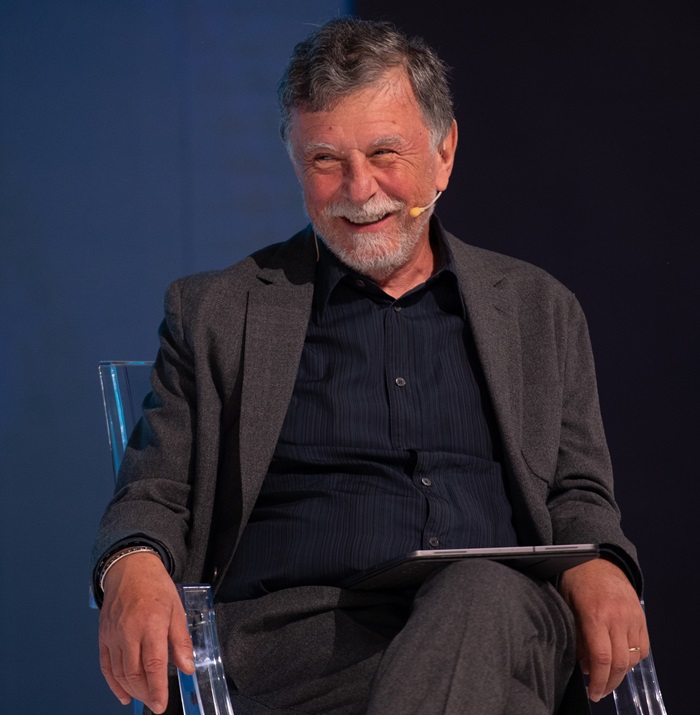
“Claiming Türkiye’s digital transformation vision early, and doing so boldly, was immensely meaningful. When only 30,000 people used the internet, we already saw the country’s future there.”
Looking back over TBV’s 30-year journey, which accomplishments have meant the most to you, the ones that make you say, “I’m glad we did this”?
Thirty years is a long journey in the life of a country and in the life of a person.
When I look back, the things that touch me the most are not individual projects but the emergence of a culture.
Claiming Türkiye’s digital transformation vision early, and doing so boldly, was immensely meaningful. When only 30,000 people used the internet, we already saw the country’s future there. Today, I appreciate the value of that early step even more.
Second, our programs that help young people and society gain the skills of the future have always been critical for Türkiye. Many young people who attended those programs are now entering professional life. Soon, many decision-makers will say, “Back in university, I participated in TBV’s training programs.”
And finally, I am proud that we introduced the concept of human- and planet-centered technology into Türkiye’s agenda. Approaching technology not only as a technical field but as a societal and ethical matter… That perspective now lies at the heart of today’s AI discussions. Each of these achievements belongs not to an institution but to a community.